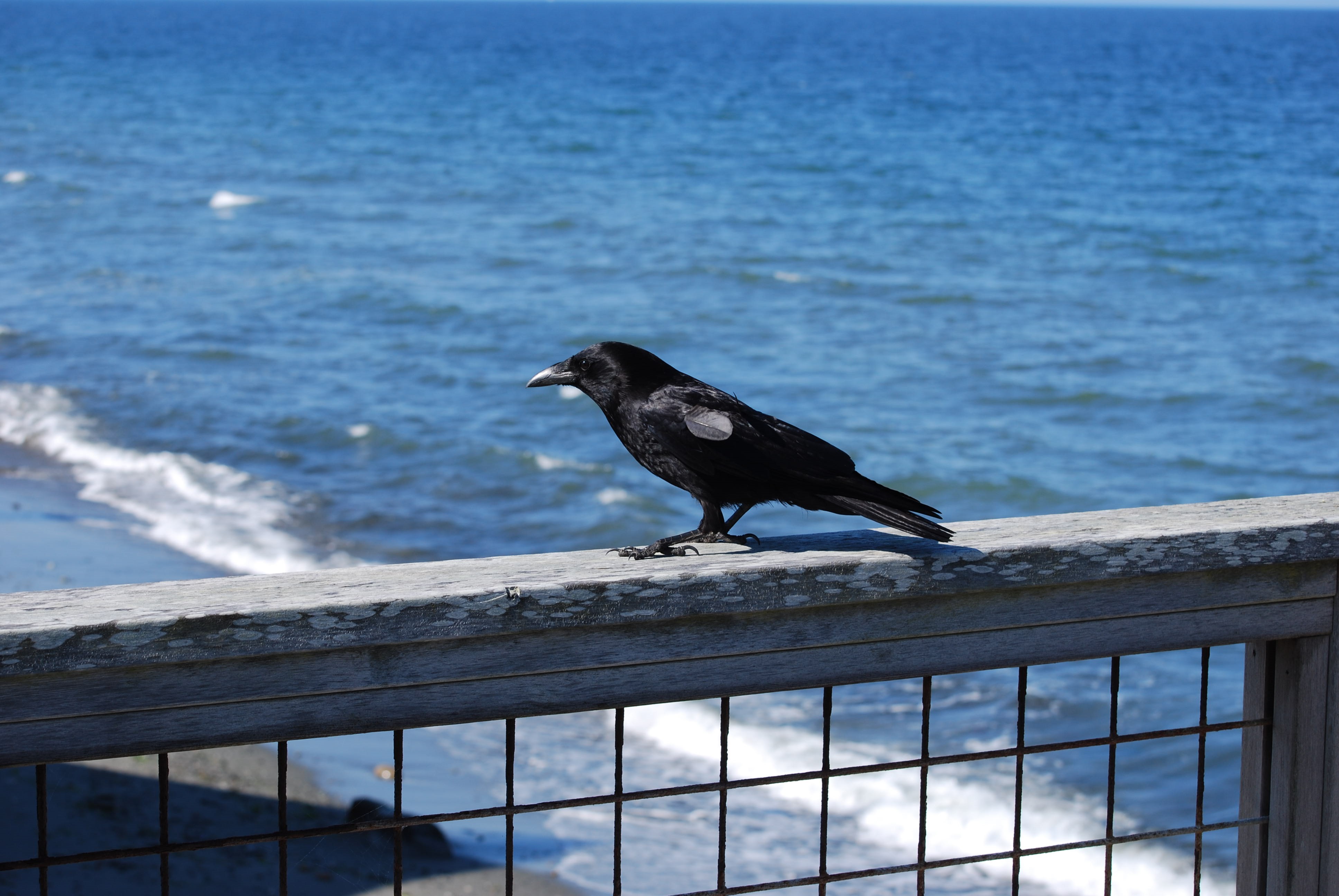
Karrr !
Posted: September 1st, 2010 under Crow.
Comments: none
Posted: September 1st, 2010 under Crow.
Comments: none
I came across these beautiful corvid sculptures by Terence Coventry and thought I would share them. According to kingsplace.co.uk,
In each of these animal and human figures Coventry masters an amazing balance between anatomy and sculptural form. He distills and refines everyday subjects into powerful and monumental images that have a connection in all of us.
Posted: August 21st, 2010 under Culture, Terence Coventry, art, corvid, jackdaw, jackdaws, sculptures.
Tags: artist, corvid, corvid sculpture, jackdaw, jackdaw sculpture, sculpture, Terence Coventry
Comments: none
Siberian jay, originally uploaded by Fredww.
The Siberian jay (Perisoreus infaustus) is a bird inhabiting old-growth coniferous taiga forests.1 The Siberian jay is found in north Eurasia. The species has a wide range (estimated global Extent of Occurrence 10,000,000km²) and a large global population (estimated 680,000-1,400,000 in Europe).2
Little more is published online about the Siberian Jay. I will do some further research in my local library and update this post at some point.
Posted: August 11th, 2010 under Corvidae, Corvidae Family, Corvids, Perisoreus infaustus, Siberian Jay.
Tags: Corvidae, Perisoreus infaustus, Siberian Jay
Comments: none
Perisoreus canadensis a.k.a Grey Jay a.k.a Whiskey-Jack, originally uploaded by zircon_215.
The Gray Jay (Perisoreus canadensis), also Grey Jay, Canada Jay, or Whiskey Jack, is a member of the crow and jay family (Corvidae) found in the boreal forests across North America north to the tree-line and in subalpine forests of the Rocky Mountains south to New Mexico and Arizona. It is one of three members of the genus Perisoreus, the others being the Siberian Jay, P. infaustus, found from Norway to eastern Russia and the Sichuan Jay, P. internigrans, restricted to the mountains of eastern Tibet and northwestern Sichuan. All three species store food and live year-round on permanent territories in coniferous forests.
Distribution
The gray jay is a native resident from northern Alaska east to Newfoundland and Labrador and south to northern California, Idaho, Utah, east-central Arizona, north-central New Mexico, central Colorado, and southwestern South Dakota. It is also a native resident in northern Minnesota, northern Wisconsin, northern Michigan, northern New York, and northern New England. The gray jay may wander north of the breeding range. In winter it travels irregularly to northwestern Nebraska, central Minnesota, southeastern Wisconsin, central Michigan, southern Pennsylvania, central New York, Connecticut, and Massachusetts.
Perisoreus canadensis albescens is a resident from northeastern British Columbia and northwestern Alberta southeastward, east of the Rocky Mountains to South Dakota (Black Hills). It is casual in northwestern Nebraska.
Perisoreus c. arcus is a resident in the Rainbow Mountains area, and headwaters of the Dean and Bella Coola Rivers of the central Coast Ranges, British Columbia.
Perisoreus c. barbouri is a resident on Anticosti Island, Quebec.
Perisoreus c. bicolor is a resident in southeastern British Columbia, southwestern Alberta, eastern Washington, northeastern Oregon, northern and central Idaho, and western Montana.
Perisoreus c. canadensis breeds from northern British Columbia east to Prince Edward Island, and south to northern Minnesota, northern Wisconsin, northern Michigan, northeastern New York, northern Vermont, northern New Hampshire, and Maine. It winters at lower altitudes within the breeding range and south to southern Ontario and Massachusetts, casually to central Minnesota, southeastern Wisconsin, northwestern Pennsylvania, and central New York. Perisoreus c. canadensis is accidental in northeastern Pennsylvania (Philadelphia).
Perisoreus c. capitalis is a resident in the southern Rocky Mountains from eastern Idaho, central south-central Montana, and western and southern Wyoming south through eastern Utah, and western and central Colorado, to central eastern Arizona and north-central New Mexico.
Perisoreus c. griseus is a resident from southwestern British Columbia and Vancouver Island south through central Washington and central Oregon to the mountains of north-central and northeastern California.
Perisoreus c. nigracapillus is a resident in northern Quebec (Fort Chimo, Whale River, and George River), throughout Labrador, and in southeastern Quebec (Mingan and Blanc Sablon).
Perisoreus c. obscurus is a resident in the coastal belt from Washington (Crescent Lake, Seattle, and Columbia River) through western Oregon to northwestern California (Humboldt County).
Perisoreus c. pacificus is a resident in north-central Alaska (Kobuk River, Endicott Mountains, and Fort Yukon), northern Yukon (Arctic Circle at the International Boundary), and northwestern Mackenzie (Mackenzie Delta and lower Horton River) south in Alaska to latitude 60° N.
Perisoreus c. sanfordi is a resident in Newfoundland and Nova Scotia.
Habitat and distribution
Perisoreus canadensis obscurus in Mount Rainier National ParkThe vast majority of Gray Jays live where there is a strong presence of one or more of black spruce (Picea mariana), white spruce (P. glauca), Englemann spruce (P. engelmanni), jack pine (Pinus banksiana), or lodgepole pine (P. contorta). Gray Jays do not inhabit the snowy, coniferous, and therefore seemingly appropriate Sierra Nevada of California where no spruce and neither of the two named pines occur. Nor do Gray Jays live in lower elevations of coastal Alaska or British Columbia dominated by Sitka spruce (Picea sitchensis). The key habitat requirements may be sufficiently cold temperatures to ensure successful storage of perishable food and tree bark with sufficiently pliable scales arranged in a shingle-like configuration that allows Gray Jays to wedge food items easily up into dry, concealed storage locations. Storage may also be assisted by the antibacterial properties of the bark and foliage of boreal tree species. An exception to this general picture may be the well-marked subspecies P. c. obscurus, once given separate specific status as the “Oregon Jay”. It lives right down to the coast from Washington to northern California in the absence of cold temperatures or the putatively necessary tree species.
Behavior
Mating
Gray jays typically breed at 2 years of age. Pairs are monogamous and remain together for their lifetime, but a male or female will find another mate following the disappearance or death of their partner. Gray jay pairs breed during March and April, depending on latitude, in permanent, all-purpose territories. Second broods are not attempted, perhaps allowing greater time for food storage.
Gray jays cooperatively breed. Strickland studied cooperative breeding of gray jays in Algonquin Provincial Park, Ontario, and La Verendrye Provincial Park, Quebec. In early June, when broods were 55 to 65 days old, the young fought amongst themselves until dominant juveniles forced their siblings to leave the natal area. Dominant juveniles, known as “stayers”, remained with their parents, and “leavers” left the natal territory to join an unrelated pair who failed to breed. Two-thirds of “stayers” were male.
During the nest-building phase of the subsequent breeding season, approximately 65% of gray jay trios included “stayers” from the previous spring and their parents, and approximately 30% of trios included an unrelated “leaver”. Occasionally, two nonbreeders accompany a pair of adults. “Stayers” may eventually inherit the natal territory and breed, and “leavers” may eventually fill a vacancy nearby or form a new breeding pair on previously unoccupied ground. The role of “stayers” is to retrieve caches and bring food to younger siblings; however, this is only allowed by the parents during the postfledgling period. Until then, parents are hostile toward the “stayer”. This may reduce the frequency of predator-attracting visits to the nest when young are most vulnerable. The benefits of allofeeding may include “lightening the load” for the breeding pair, which may possibly increase longevity, reducing the probability of starvation of nestlings, and detecting and mobbing predators near the nest.
Read more »
Posted: August 10th, 2010 under Canada Jay, Crow, Gray Jay, Grey Jay, Perisoreus canadensis, Whiskey Jack.
Tags: Canada Jay, Corvidae, Gray Jay, Grey Jay, Perisoreus canadensis, Whiskey Jack
Comments: none
Alpine Chough – Alpendohle, originally uploaded by floecky.
The Alpine Chough, or Yellow-billed Chough, (Pyrrhocorax graculus) is a bird in the crow family, one of only two species in the genus Pyrrhocorax. Its two subspecies breed in high mountains from Spain east through southern Europe and North Africa to Central Asia, India and China, and it may nest at a higher altitude than any other bird. The eggs have adaptations to the thin atmosphere that improve oxygen take-up and reduce water loss.
This bird has glossy black plumage, a yellow bill, red legs, and distinctive calls. It has a buoyant acrobatic flight with widely spread flight feathers. The Alpine Chough pairs for life and displays fidelity to its breeding site, which is usually a cave or crevice in a cliff face. It builds a lined stick nest and lays three to five brown-blotched whitish eggs. It feeds, usually in flocks, on short grazed grassland, taking mainly invertebrate prey in summer and fruit in winter; it will readily approach tourist sites to find supplementary food.
Although it is subject to predation and parasitism, and changes in agricultural practices have caused local population declines, this widespread and abundant species is not threatened globally. Climate change may present a long-term threat, by shifting the necessary alpine habitat to higher altitudes.
Read more »
Posted: August 9th, 2010 under Alpendohle, Alpine Chough, Corvidae, Corvidae Family, Corvids, Crow, Pyrrhocorax graculus, Yellow-billed Chough, chough, corvid.
Tags: Alpendohle, Alpine Chough, Pyrrhocorax graculus, Yellow-billed Chough
Comments: none
Green Magpie (Cissa chinensis), originally uploaded by cliff1066™.
The Green Magpie is a member of the Crow family, roughly about the size of the Eurasian Jay or slightly smaller. It is a vivid green in color, slightly lighter on the underside and has a thick black stripe from the bill (through the eyes) to the nape. The tail is quite long and tapered with white tips. This all contrasts vividly with the reddish fleshy eye rims, red bill and legs. The wing primaries are reddish maroon also and make this one of the most striking and distinctive members of the whole family. It is found from the lower Himalayas in north eastern India in a broad south easterly band down into central China, Malaysia, Sumatra and northwestern Borneo in evergreen forest (including bamboo forest), clearings and scrub.
Posted: August 7th, 2010 under Cissa chinensis, Corvidae, Corvidae Family, Corvids, Crow, Green Magpie, corvid.
Tags: Cissa chinensis, green magpie
Comments: none
A kind man named Andrew brought to my attention Jackie, an albino jackdaw, who lives in the trees of Avesbury (in the UK), the largest stone circle in the world, in SW England.
Avebury Stone Circle, originally uploaded by Quentin C.
As majestic as the place is the albino jackdaw, locally named ‘Jackie’, who lives in the woods nearby this mystical place. Here is a picture and a video of Jackie kindly sent to me by Andrew (thank you Andrew!),
According to Andrew,
Jackie was first spotted on June 29, and is about two months old now. Obviously, being at such a magical place is significant, especially as white animals with red eyes were seen as guides to the otherworld in Celtic mythology.
Fantastic point! Thanks again Andrew! Here is the video he shared with us,
Posted: August 6th, 2010 under Albino, Albino Jackdaw, Crow, Jackie, Stone circle of Avesbury, UK, jackdaw, jackdaws.
Tags: albino and jackdaw, albino corvid, albino jackdaw, albino jackdaw in avesbury, Avesbury, jackdaw, jackdaw and albino, Jackie the albino jackdaw, stone circle in Avesbury, UK
Comments: none
Pêga-azul / Azure-winged Magpie (Cyanopica cyanus), originally uploaded by Armando Caldas.
The Azure-winged Magpie (Cyanopica cyana) is a bird in the crow family. It is 31–35 cm long and similar in overall shape to the European Magpie (Pica pica) but is more slender with proportionately smaller legs and bill. It belongs to the monotypical genus Cyanopica.
It has a glossy black top to the head and a white throat. The underparts and the back are a light grey-fawn in colour with the wings and the feathers of the long (16–20 cm) tail are an azure blue. It inhabits various types of coniferous (mainly pine) and broadleaf forest, including parks and gardens in the eastern populations.
It occurs in two population groups separated by a huge geographical region between. One population lives in Western Europe, specifically the southwestern part of the Iberian Peninsula, in Spain and Portugal. The other population occurs over a much larger region of eastern Asia in most of China, Korea, Japan, and north into Mongolia. Recent genetic analysis has shown that the two populations are distinct at species level, under which the Iberian Azure-winged Magpie would take the name Cyanopica cooki, though this change has yet to be formally incorporated in the European bird list.
Often Azure-winged Magpies find food as a family group or several groups making flocks of up to 70 birds. The largest groups congregate after the breeding season and throughout the winter months. Their diet consists mainly of acorns (oak seeds) and pine nuts, extensively supplemented by invertebrates and their larvae, soft fruits and berries, and also human-provided scraps in parks and towns.
This species usually nests in loose, open colonies with a single nest in each tree. There are usually between 6–8 eggs that are incubated for 15 days.
The voice is a quick fired and metallic sounding kwink-kwink-kwink usually preceded by a single krarrah.
(Source: wikipedia.com)
Posted: August 5th, 2010 under Azure-winged Magpie, Corvidae Family, Crow, Cyanopica cyanus, Magpie.
Tags: azure winged magpie, Azure-winged magpie, cyanopica cyana, magpies
Comments: none
Racket-tailed Treepie (Crypsirina temia), originally uploaded by sesamest74.
The Black Racket-tailed Treepie (Crypsirina temia) is an Asian treepie, a member of the Corvidae (crow) family.
It has a velvety-black forehead of short, plush black feathers with the rest of the bird being an oily green colour, though appearing black in dim light. The tail feathers which in this species are long and broaden at the tail’s end are black also with a greenish tinge, as are the wings. The iris of the bird is a turquoise-blue darkening towards the pupil to a very deep or near black. The bill, legs and feet are black.
This bird occurs in southern Burma (Myanmar), Thailand, Indo-China, Sumatra, Java and Bali in scrub and secondary growth, open fields and gardens, bamboo thickets and open forest often near villages.
It almost always feeds in trees (arboreal) never feeding from the ground though coming down to bathe on occasion. It moves through the trees with great agility and uses its remarkable tail as a balancing organ. It eats mainly insects and fruit.
A cup shaped nest is built in bamboo or shrubs especially thorny ones often surrounded by open grassy areas and normally lays 2–4 eggs.
The voice is usually described as harsh and unattractive. It has several described calls but a whining call is often heard.
(Source: wikipedia)
Posted: August 4th, 2010 under Asian treepie, Corvidae, Corvidae Family, Crow, Crypsirina temia, Racket-tailed Treepie, Ratchet-tailed Treepie.
Tags: Asian treepie, Black Racket-tailed Treepie, Corvidae, Crypsirina temia, racket-tailed treepie
Comments: none
Collared Treepie, originally uploaded by Dr.Supriyo Samanta.
The Black-faced or Black-browed Treepie (Dendrocitta frontalis) is an Asian treepie, a small perching bird of the Corvidae (crow) family.
This bird is slightly smaller than a Blue Jay and has the typical compact body and long tail of this group. The forehead, face and bib are black with the chest, neck and shoulders a light silvery or bluish-grey in colour. The back is a warm chestnut brown with similar underparts. The wing coverts are white with the primaries and tail black.
It inhabits a broad band (though often very localised) from the north eastern Indian Himalayas, Nepal and across into Burma (Myanmar) in hill forests often at quite high elevations.
It feeds mainly on invertebrates of various types, and hawks for termites in flight; it also eats fruits and berries. It probably takes similar overall food types as the other treepies.
The nest is a small, neat structure often placed in bamboo clumps, small trees or bushes at the edge of a clearing. There are usually 3-5 eggs laid.
The voice is described as varied but contains metallic notes as well as the chatter alarm call sounding similar to the other species.
(Source: Wikipedia)
Posted: August 3rd, 2010 under Black-browed Treepie, Black-faced Treepie, Collared Treepie, Corvidae, Corvidae Family, Crow, Dendrocitta frontalis.
Tags: Asian treepie, Black-browed Treepie, Black-faced Treepie, Collared Treepie, Dendrocitta frontalis
Comments: none